Versori is now part of Avalara

On-Demand Connectors

Learn more about Versori

How Fluent Commerce Accelerates Customer Launches With On-Demand Connector Development

For enterprise retailers, a typical order management implementation can require 5 to 30+ integrations before the system is fully operational. For Fluent Commerce, one of the leading distributed order management platforms, this created a familiar industry challenge: How do you reduce the time it takes to connect everything together?

"We wanted to be able to say yes when customers asked if we could integrate with anything in their ecosystem, but not by building a huge library of connectors that no one would actually use. We wanted to do it in a way that met the needs of the enterprise and was easy to maintain.
Nicola Kinsella
Chief Strategy Officer, Fluent Commerce
Faster Implementations

From multiple deployment sprints, to on-demand delivery.

About

Fluent Commerce is a global software company focused on inventory availability data management at scale and distributed order management (DOM) for commerce.

Industry

Retail & Ecommerce

Company Size

51–200

Headquarters

Sydney, Australia

Systems Integrated

More information coming soon...

Order Management sits at the centre of modern e-commerce operations

Every order touches multiple systems: commerce platforms, ERPs, warehouse management systems, point-of-sale systems, tax engines, payment gateways, shipping providers, and marketplaces.

For enterprise retailers, a typical order management implementation can require 5 to 30+ integrations before the system is fully operational.

For Fluent Commerce, one of the leading distributed order management platforms, this created a familiar industry challenge: How do you reduce the time it takes to connect everything together?

Because while the Fluent OMS itself can be deployed quickly, integration work often becomes the longest and most complex part of the project.

Integration complexity slowing time-to-value

Enterprise retailers rarely run simple technology stacks. A typical Fluent Commerce implementation may need to connect with:

  • ERP's maintaing system of record data and financials
  • Warehouse management systems controlling fulfilment
  • Point-of-sale systems inside physical stores
  • Ecommerce platforms powering online storefronts
  • Marketplaces and external sales channels
  • Tax, payments, and carriers supporting transactions

This web of systems creates significant integration overhead during implementation. In many OMS projects, as much as half of the implementation effort can become integration work.

"The real challenge is scale. When you are dealing with Ecommerce transactions everything needs to move at near real-time.  In our evaluation of IPaaS solutions Versori stood out as the one being able to handle that kind of speed and volume in a cost effective manner."
Nicola Kinsella
Chief Strategy Officer, Fluent Commerce

Historically, this has been addressed in two ways

1. Pre-built connectors marketed as out-the-box

In reality, enterprise environments almost always require customisation, custom attributes, bespoke workflows, and unique data structures.

2. Custom integrations built and managed in-house or by 3rd party dev

While flexible, this approach increases project timelines and costs, often requiring one or two development sprints per connector depending on complexity.

At the same time, Fluent Commerce needed to ensure that any integration solution could meet the performance requirements of high-volume E-commerce environments.

Many traditional iPaaS tools struggle in this context. They are designed primarily for non-transactional data flows where latency is acceptable.

But For E-commerce Operations:

Order updates must happen near real-time

Inventory changes must propagate immediately

Fulfilment decisions depend on accurate, up-to-date data

Fluent Commerce needed a solution capable of handling high transaction volumes while dramatically reducing connector development time.

Learn more about Versori
"When a customer asks if we can integrate with something, we can just say yes and make it happen. We’re not relying on a half-baked connector that was built years ago and hoping it still works."
Chad Hooker
SVP Global Channel & Alliances, Fluent Commerce

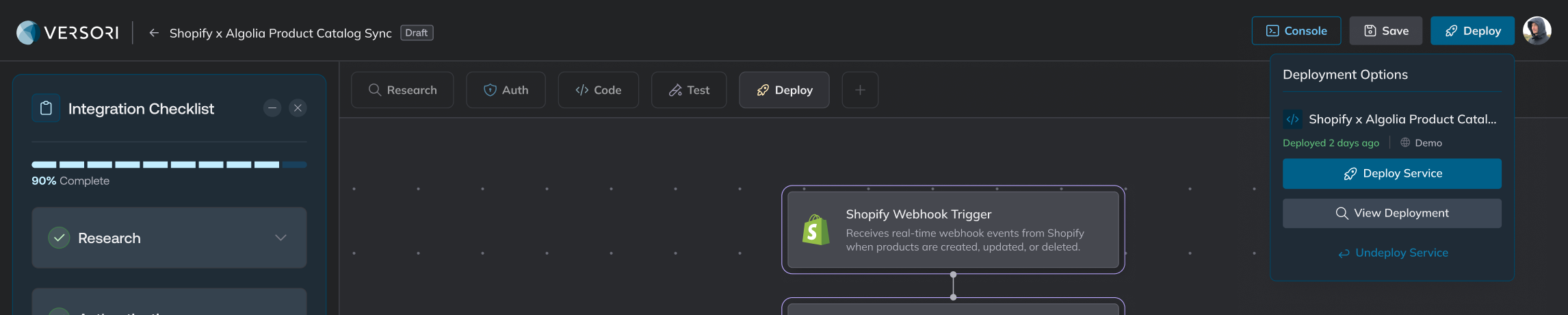
AI-Generated Connectors With Versori

This allows the team to say “yes” when customers ask: “Can you integrate with this system?”

To solve this challenge, Fluent Commerce partnered with Versori to transform how integrations are created and deployed. Instead of building and maintaining large libraries of rigid, generic connectors, Fluent Commerce uses Versori to rapidly generate connectors tailored to each customer’s environment.

Using Versori internally, Fluent Commerce can:

Rapidly generate connectors based on third-party system specifications

Adapt integrations to match bespoke enterprise data models

Ensure performance at the transaction scale required for ecommerce operations

The result is a model where connectors are created on demand rather than pre-built and maintained indefinitely.

“Integration anxiety becomes a thing of the past. Versori removes a huge amount of risk and cost from an order management projects because teams are always worried about timelines and budgets. Suddenly, that entire integration challenge is no longer the blocker.”
Chad Hooker
SVP Global Channel & Alliances, Fluent Commerce

An Integration Approach Designed To Complement, Not Replace

Fluent Commerce builds connectors internally using Versori, while system integrators remain closely involved in the implementation process.

System integrators continue to:

Define integration specifications

Design end-to-end data flows

Test integrations in customer environments

Once the data flow is defined, Fluent Commerce creates the connector using Versori, after which the SI validates and tests the implementation. This creates a continuous feedback loop between Fluent Commerce, implementation partners, and customers.

The outcome is a hybrid model where:

Integration development is significantly faster

Implementation partners remain central to project delivery

Customers reach production sooner

Learn more about Versori
“Rather than replacing SIs, this approach complements them. We handle the build, hosting, and management of integrations, while continuing to collaborate closely on solution architecture and testing."
Chad Hooker
SVP, Global Alliances & Business Development, Fluent Commerce

A 15 month journey to production readiness

The partnership between Fluent and Versori began in Q2 2024.

It was initially focused on testing whether AI-generated connectors could meet enterprise-grade requirements.

Early work centred on creating proof-of-concept integrations capable of demonstrating full end-to-end workflows in live demo environments.

Over the following 15 months, the teams worked together to ensure the Versori platform could:

Handle production-level transaction volumes

Maintain reliablity in real-time commerce environments, at scale

Integrate with complex enterprise data models

This collaborative development ensured that the solution was not only technically viable but ready for production deployments.

Faster Integrations and expanded opportunities

Projects that previously required multiple development sprints per connector can now be delivered significantly faster.

By reducing the time required to build integrations, Fluent Commerce can help customers achieve faster time-to-value from OMS implementations.

This has several downstream benefits:

Faster customer launches.

Retailers and brands can implement order management systems more quickly, accelerating Ecommerce transformation initiatives.

Reduced implementation costs.

Stronger competitive positioning

Budgets previously allocated to low-value integration development can be redirected toward higher-value, more strategic initiatives delivered by the system integrator.

Fluent Commerce can confidently support a broader range of customer ecosystems, removing integration barriers during the sales process.

Unlocking additional uses for order management data

The ability to create integrations quickly also opens the door to entirely new categories of data connectivity.

Traditionally, OMS integrations focus on operational systems. However, Fluent Commerce is now exploring opportunites to connect order management data with other systems across the business, for example...

1. Advertising Platforms

Some customers are connecting inventory data to advertising platforms to optimise ad spend. Campaigns can automatically prioritise products that are:

In stock

Available locally

Ready to ship

This prevents wasted advertising spend on unavailable products while improving campaign performance.

2. Demand Forecasting

Integrating demand forecasting data with the OMS enables retailers to improve order sourcing decisions. For example, if an item is forecast to sell out in a particular store due to high foot traffic, the system can automatically fulfil online orders from another location instead.

3. Product Information Management

Order and returns data can also inform product content improvements. Retailers may prioritise updating product descriptions or imagery for items with high return rates to improve conversion and reduce operational costs.

These examples illustrate a broader shift: Order management data can become a strategic asset across the business when it is easily accessible through integrations.

Expanding the possibilities of connected commerce

For Fluent Commerce, the partnership with Versori is about more than speeding up integrations. It is about enabling a future where retailers can connect systems freely and unlock new ways to utilise their data. By combining distributed order management with AI-generated integrations, Fluent Commerce can help retailers launch faster, integrate more systems, and unlock new value from their commerce data.


Ready to level up
your integrations?

Get a technical deep dive on the Versori platform.

Book Demo

Enterprise Integrations
Built in Days

Agents scope, authenticate, deploy and maintain your integrations in days, not months.